AARG

Author name: Reemal Shah

Agile Maturity Assessment

These are the five phases of Agile maturity of any organization: 1. The Agile Team :  Single agile team, consisting of a Scrum Master, Product Manager and developers, working on each product backlog items 2. Teams of Agile Teams : Multiple agile teams, consisting of one or more Scrum Master, Product Owners and developers 3. Scaling Agile Organization: Organizations functioning in Agile Release Train structures but lack Alignment on goals or objectives 4. Agile Enterprise: Multiple teams of teams delivering consistently towards the same value delivery and business value delivery is predictable 5. Scaling Agile Enterprise: Business value delivery and quality across portfolios is consistent
Agile Transformation Office (ATO)

Establishing an agile transformation office (ATO) can improve the odds of success. Whether your transformation aims at only part of the enterprise or across the whole of it, a successful journey should have a structured approach that can deliver value. An ATO shapes and manages the transformation, brings the full organization along, and—perhaps most important—helps it achieve lasting cultural change. The ATO is not meant to be an oversight board or another layer of bureaucracy. Instead, it is embedded within the existing structure, pulling in the right business expertise to realize tangible outcomes. Becoming a truly agile organization is a long-term proposition that takes place in phases. A centralized ATO can not only propel the transformation but also ensure the “stickiness” of cultural change across an organization. It helps identify and resolve issues that can slow the pace of the transformation and keeps the focus on creating value.  In essence, agility at an enterprise level means moving strategy, structure, processes, people, and technology toward a new operating model. It achieves all this by rebuilding an organization around hundreds of self-steering, high-performing teams (supported by a stable backbone) and by changing the organizational culture. An agile transformation is both comprehensive and iterative. It is comprehensive because it clearly defines what the organization is trying to achieve and creates the processes and structures needed to reach these goals. It is iterative because it requires the organization to test, learn, and correct course as each part of the new operating model is implemented

Scaled Agile Framework

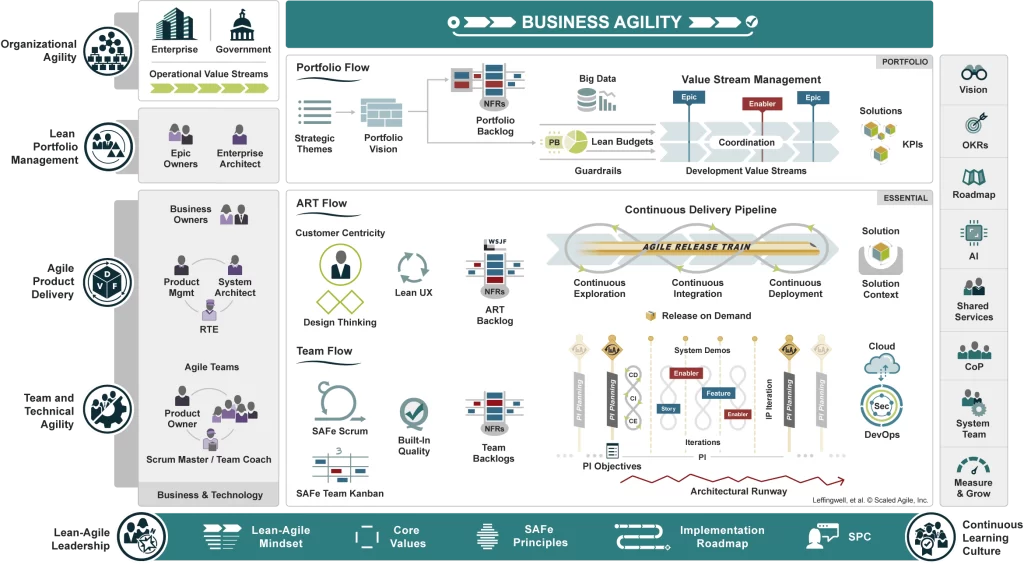
WHAT IS SCALED AGILE FRAMEWOK IN A NUTSHELL? The Scaled Agile Framework (SAFe) is a set of principles, practices, and competencies for scaling Agile methodologies to large enterprises. It provides a framework for organizing and coordinating the work of multiple Agile teams and aligning their efforts with the larger goals of the organization. SAFe is based on Agile principles, such as customer focus, continuous improvement, and collaboration, but it adds additional layers of structure and coordination to enable larger-scale projects. It is designed to help organizations: Align their work with strategic business objectives Coordinate the efforts of multiple teams and stakeholders Deliver value to customers more quickly and efficiently Continuously improve their processes and practices. SAFe consists of three levels: the team level, the program level, and the portfolio level. At each level, there are specific roles, artifacts, and ceremonies to help teams collaborate and coordinate their work. SAFe has become a popular framework for large enterprises that are adopting Agile methodologies, particularly in industries such as finance, healthcare, and government. It is supported by a large community of practitioners, as well as training and certification programs.

Agile Transformation

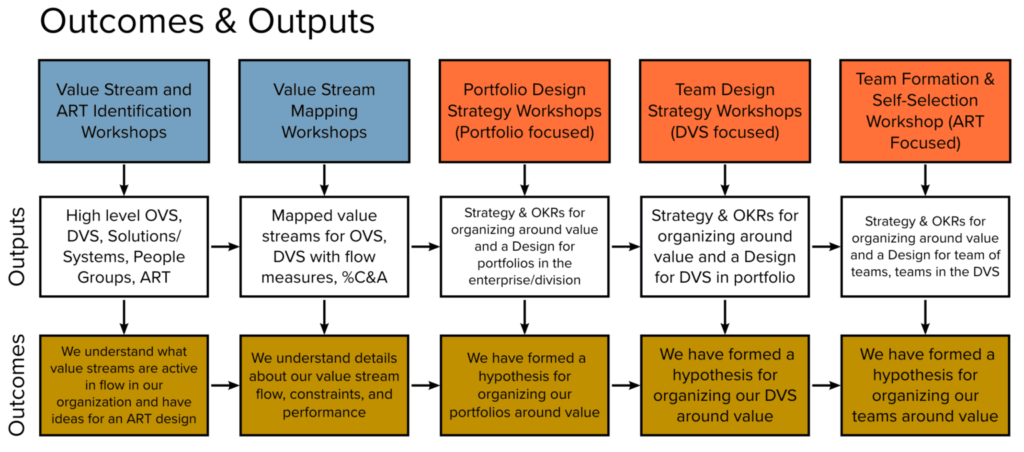
A PATTERN FOR TEAM DESIGN STRATEGY & SELF-FORMATION WORKSHOP EVENTSIn this series of articles, Agile Rising’s Scaled Agile experts has introduced and provided recommendations on peer-reviewed and field-tested ideas and patterns for organizing around value while using SAFe as guidance. The patterns include critical features of design thinking, Agile, and applied Lean and Systems Thinking. SERIES ARTICLE TOPICSPart 1: Organizing & Forming Agile Teams Around Value with SAFe®Part 2: What is Team Design Strategy and the Challenges?Team Design Strategy with Value Streams, Design Thinking, and Team TopologiesPart 3: Team Design Strategy – Where do we start?Part 4: Team Design Strategy – WorkshopPart 5: Team Formation & Self-Selection WorkshopPart 6: Design Thinking & Feedback LoopsPart 7: Preparing and Connecting SAFe Workshops (VSI and VSM)Part 8: Continuity with Enterprise Strategy, VMO, Strategic Themes and OKRs – Goal Setting

Scroll to Top